


The past decade has witnessed an unprecedented surge in educational technology adoption. From learning management systems to AI-powered tutoring platforms, institutions have invested billions in digital tools, believing that technology alone would revolutionize learning. The pandemic accelerated this trend, pushing education online almost overnight and creating an urgent demand for digital solutions.
Yet as we approach 2026, a critical realization is emerging that the most sophisticated technology in the world cannot compensate for poorly designed learning experiences.
While the EdTech industry continues to innovate at breakneck speed, the real differentiator between transformative education and disappointing digital classrooms isn't the technology itself but rather the instructional design that shapes how learners interact with it.
The institutions that will thrive in 2026 and beyond will not be those with the newest platforms or the flashiest tools. They will be the ones that recognize instructional design as the strategic advantage that turns technology from a mere delivery mechanism into a powerful catalyst for learning.
The Current State of EdTech: Technology-First, Learning Second
Walk into any institutional planning meeting about digital transformation, and you will likely hear extensive discussions about which LMS to adopt, whether to invest in VR capabilities, or how AI can automate grading. These are important conversations, but they reveal a fundamental misalignment in priorities.
Educational institutions globally invest billions of dollars annually in EdTech solutions. However, research consistently shows that technology implementation without pedagogical grounding produces disappointing results. Studies examining digital learning initiatives across universities have found that institutions with high technology investment but low instructional design capacity report significantly lower student satisfaction rates compared to those with balanced approaches.
Free Guide: Intro to Course Creation
Ready to turn your expertise into an online course? Enter your details below to receive the guide instantly.
The pattern is troublingly consistent: institutions purchase comprehensive digital platforms, conduct brief training sessions on technical features, and then wonder why engagement drops, completion rates plummet, and faculty resistance grows. The missing ingredient is not more sophisticated technology but thoughtful, evidence-based instructional design that bridges the gap between technological capability and meaningful learning.
Consider the typical scenario below
A university invests in a state-of-the-art LMS with discussion forums, multimedia integration, and analytics dashboards. Yet faculty simply replicate their lecture notes as PDF uploads, creating what researchers call ‘digitized correspondence courses’ rather than engaging online learning experiences.
The technology enables interaction, collaboration, and personalization, but without intentional instructional design, these possibilities remain untapped.
Why Instructional Design Matters More
Instructional design is the systematic process of creating learning experiences that facilitate knowledge acquisition and skill development. In my experience, it is instructional design makes the difference between a course that leverages technology effectively and one that merely delivers content through digital channels.
As we move toward 2026, I have identified three compelling reasons explain why instructional design will eclipse technology as the critical success factor.
Direct Impact on Learning Outcomes
First, instructional design directly impacts learning outcomes, engagement, and retention. The University of Central Florida's Center for Distributed Learning demonstrated this through their Digital Learning Course Redesign Initiative. By applying rigorous instructional design principles to redesign 200 online courses, they achieved a 10% increase in student success rates, a 15% improvement in retention, and significantly higher satisfaction score without changing the underlying technology platform.
The transformation came from applying principles like chunking content for cognitive load management, designing authentic assessments, incorporating spaced practice, and creating meaningful learner interactions.
Maximizing Technology ROI
Second, effective instructional design maximizes the return on technology investment. Arizona State University's adaptive learning initiative illustrates this principle. Rather than simply implementing adaptive technology, they invested heavily in instructional designers who worked with faculty to redesign entire course pathways, create meaningful checkpoints, and develop interventions for struggling learners.
The result was transformative: in College Algebra, student success rates increased by 17 percentage points (from 57% to 85%), while Introduction to Biology saw a 24% improvement in pass rates and a 90% reduction in dropout rates, particularly benefiting historically underserved students.
Creating Scalable Excellence
Third, instructional design creates scalable, replicable excellence. Technology can distribute content to thousands simultaneously, but only well-designed instruction ensures that those thousands have equitable, high-quality learning experiences. The Quality Matters (QM) framework demonstrates this principle on a global scale. Developed in 2003 to solve the challenge of ensuring consistent course quality across institutions, QM provides research-based instructional design standards and a peer-review process.
Over 1,500 colleges and universities worldwide have adopted these standards, with a community of roughly 100,000 members and thousands of certified online courses. This systematic approach to instructional design enables institutions to deliver quality at scale, ensuring that whether a student takes a course at one university or another, they receive a consistently high-quality learning experience grounded in evidence-based design principles.
The Future of EdTech: A Balanced Approach
The future of education technology isn't technology versus instructional design but rather technology amplified by instructional design. As we approach 2026, successful institutions will embrace a balanced approach that treats technology as an enabler and instructional design as the strategic framework that determines what gets enabled and how.
Think of it this way: Technology provides the canvas and tools, but instructional design creates the masterpiece.
AI can personalize content delivery, but instructional designers determine what personalization means in the context of specific learning objectives.
Virtual reality can immerse learners in simulated environments, but instructional designers craft the experiences that make those environments pedagogically meaningful.
Analytics can track every click and interaction, but instructional designers interpret that data to make evidence-based improvements.
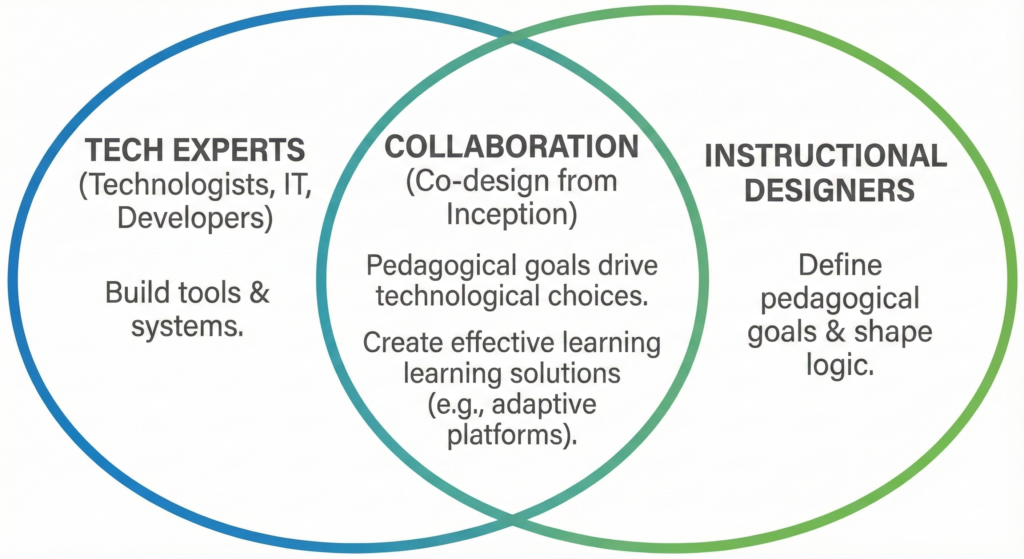
Some forward-thinking institutions are already making this shift by establishing a structure where tech experts (including technologists, IT staff, and software developers) and instructional designers collaborate from project inception. Rather than tech experts building tools that instructional designers must retrofit for learning purposes, they co-design solutions where pedagogical goals drive technological choices. This collaborative model will produce innovations like adaptive case-study platforms that adjust complexity based on demonstrated reasoning skills, not just answer correctness. Such a distinction is only possible when instructional designers shape the fundamental logic of the system.
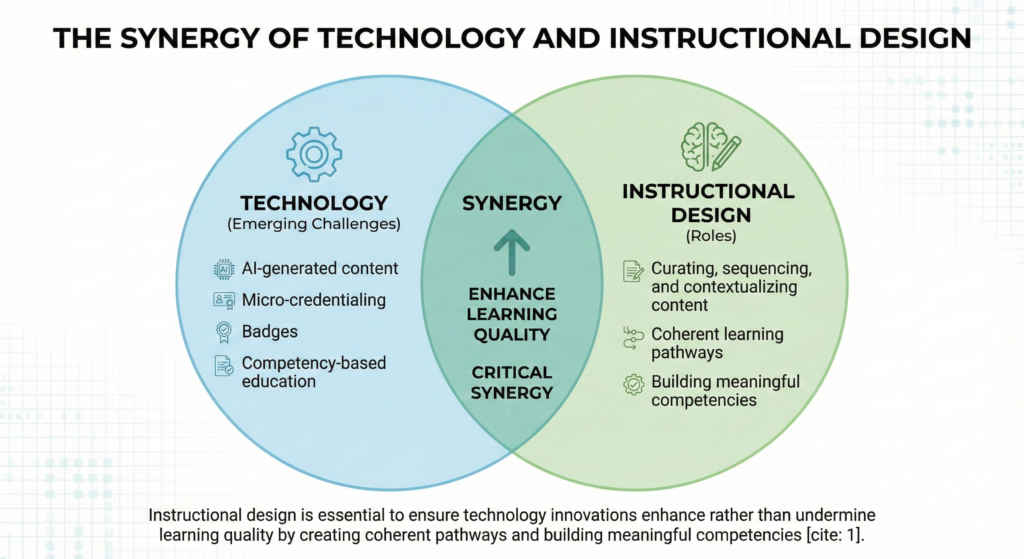
The synergy between technology and instructional design becomes even more critical as we face emerging challenges like AI-generated content, micro-credentialing, and competency-based education. These innovations require sophisticated instructional design to ensure they enhance rather than undermine learning quality. For instance, as AI makes content creation easier, instructional designers become essential for curating, sequencing, and contextualizing that content within coherent learning pathways. As credentials fragment into badges and micro-credentials, instructional designers ensure these components build toward meaningful competencies rather than becoming disconnected skill fragments.
Practical Steps for Institutions
An institution that is ready to prioritize instructional design alongside technology investment, should consider these actionable steps:
1. Conduct an instructional design capacity audit. Before investing in new technology, assess whether you have adequate instructional design support to leverage it effectively. A useful benchmark: institutions should aim for one instructional designer for every 50-100 faculty members actively teaching online or hybrid courses. If your ratio is significantly higher, technology investments will likely underperform.
2. Establish a ‘design-first’ technology adoption policy. Require that all technology purchases include a comprehensive implementation plan developed in collaboration with instructional designers. This plan should address how the technology will be integrated into course design, what training faculty will need, and how success will be measured from a learning outcomes perspective.
3. Create faculty-designer partnerships for course development. Move beyond one-time consultations to sustained collaboration models. The most successful programs treat this as a year-long partnership that includes design, implementation, evaluation, and iterative improvement.
4. Invest in professional development that emphasizes design thinking. Offer workshops, certificate programs, and communities of practice focused on instructional design principles. Topics should include backward design, universal design for learning, cognitive load theory, assessment design, and facilitation strategies. Make participation valuable through recognition systems, career advancement opportunities, or teaching excellence awards.
5. Build internal instructional design capacity. While external consultants can provide specialized expertise, developing internal capacity ensures sustained, culturally-relevant support. Hire instructional designers with diverse backgrounds who understand your institutional context, student demographics, and strategic priorities. Provide them with ongoing professional development and clear career pathways.
6. Implement quality assurance processes focused on instructional design. Develop rubrics or standards for online and hybrid course quality that prioritize pedagogical elements like clear learning objectives, aligned assessments, meaningful interactions, and accessible design. Use these not punitively but as frameworks for continuous improvement.
7. Share success stories and evidence. Document and publicize cases where instructional design improvements led to better outcomes. Create internal showcases where faculty can present innovative instructional approaches. Build an evidence base that demonstrates the impact of design investment on student success, retention, and satisfaction.
As we stand at the threshold of 2026, the educational landscape continues to evolve rapidly. New technologies will emerge, promising to revolutionize learning once again. But the institutions that truly transform educational outcomes won't be those that chase every technological innovation but rather those that strategically leverage technology through the lens of excellent instructional design.
The question for 2026 is not whether your institution uses the latest EdTech but it's whether you have the instructional design expertise to make that technology matter.