
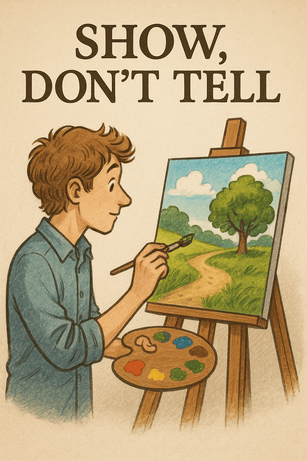

As a burgeoning author, one of the most crucial pieces of advice you will encounter is ‘show, don’t tell.’ You will hear from established authors and editors. This concept isn't just a suggestion; it’s fundamental to creating the kind of engaging and immersive stories that truly resonate with your readers.
But what exactly does this technique entail, and more importantly, how can you practically apply it to your craft? Let’s dive in and explore this essential pillar of powerful prose.
My first vivid experience with the sheer power of 'show, don't tell' in literature was when I read Chinua Achebe's masterful novel, Things Fall Apart, where the opening lines immediately paint a visceral picture of Okonkwo's fame.
Achebe doesn't simply state that Okonkwo is a renowned warrior; he shows us through the reactions of those around him and the immediate impact of his actions. This approach not only informs us of Okonkwo's status but also immerses us in the world of the Igbo people, making us feel the weight of his reputation and the profound respect he commands.
My own journey mastering this technique began during a creative writing workshop. My trainer gave us a seemingly simple task: ‘Describe John as a bad kisser.’ At first, I struggled, tempted to simply write, ‘John is a bad kisser.’ The challenge, of course, was to show, not tell. I had to convey his ineptitude through actions, awkward sensations, and his partner’s uncomfortable reactions. It was a gruelling exercise, but it taught me the value of engaging the reader's senses and emotions. Instead of a flat statement, I learned to paint a picture that left the reader feeling John's clumsy attempts and the resultant discomfort.
Free Guide: Intro to Course Creation
Ready to turn your expertise into an online course? Enter your details below to receive the guide instantly.
Understanding 'Show, Don’t Tell'
'Show, don't tell' is a writing technique that instructs authors to convey information be it facts, emotions, or setting details, through actions, vivid dialogue, and sensory description rather than through direct summary or simple statements. Instead of telling the reader how a character feels or what is happening, you show them via concrete details and interactions. This methodology allows readers to experience the story firsthand, drawing their own conclusions and becoming far more invested in the narrative and its characters.
Why It Matters
Imagine reading a story where the author constantly tells you what's happening. It might sound something like this: "Kanini was nervous. The room was quiet. She felt a lump in her throat." While this effectively conveys the information, it does absolutely nothing to engage the reader's senses or emotions.
In contrast, showing the scene might look like this:
"Kanini's palms were slick with sweat as she gripped the door handle. The ticking of the grandfather clock on the wall echoed in the sudden silence, each second stretching into eternity. Her heart hammered against her ribs, and she swallowed hard, trying to dislodge the stone that had formed in her throat."
By showing the scene, you allow the reader to feel Kanini's palpable nervousness, hear the suffocating quiet, and physically experience the tension. This immersive approach transforms a mundane event into a compelling and memorable moment.
Practical Steps: How to "Show, Don’t Tell"
To master this technique, focus on replacing abstract statements with concrete, sense-based details.
1. Harness Sensory Details
Engage all five senses to create a rich, immersive environment for your reader. Describe precisely what characters see, hear, smell, taste, and touch.
- Instead of saying(telling): "Muthurwa market was busy."
- Show the bustling scene: "Muthurwa market teemed with life. Vendors bellowed their wares, their voices a vibrant cacophony of enticing offers. The air hung thick with the pungent scent of turmeric and over-ripe mangoes, and the September afternoon sun beat down, casting a warm, golden haze across the crowded stalls."
2. Demonstrate Emotions Through Action and Dialogue
Never simply state how a character feels. Instead, allow their emotions to be revealed through their physical behaviour and spoken words.
- Instead of saying(telling), "Kababa was angry."
- Show his rage: "Kababa’s face flushed a deep crimson, and his fists clenched so tightly his knuckles shone white. 'How could you do this to me?' he spat, his voice trembling with raw, unrestrained fury."
3. Utilise Figurative Language
Metaphors and similes are powerful literary tools that can paint vivid pictures and convey complex ideas in just a few words, injecting immediate emotional resonance.
- For example: "Her heart hammered against her chest like a frantic drummer" or "The silence in the room was as heavy as a wet wool blanket."
4. Be Wary of Adverbs and Clichés
Overusing adverbs (especially those ending in -ly) and relying on tired clichés can make your writing feel passive, flat, and unoriginal. They often tell the reader how something was done, rather than showing what was done.
- Instead of telling: "She spoke softly."
- Show the softness: "Her voice was a gentle, almost timid whisper, barely audible over the rustling leaves."
5. Trust Your Reader
The sign of a truly confident writer is the willingness to avoid over-explaining. Give your readers credit for being able to infer, interpret, and feel. A few well-placed, concrete details can speak volumes more than paragraphs of summary.
Practice Makes Perfect
Mastering the "show, don't tell" technique is a commitment that requires continuous practice. Start by systematically identifying those sections in your current work where you are summarizing rather than illustrating. Then, rewrite those passages to fully engage the senses and convey emotions through tangible actions and dynamic dialogue.
Read widely, and consciously analyse how your favourite authors successfully employ this technique. With time, focused effort, and dedication, you will develop a keen eye for showing rather than telling, thereby elevating your writing to new and impressive heights.
"Show, don’t tell" is far more than just a simple writing tip; it's a profound philosophy that transforms your stories from mere narratives into fully immersive experiences. By effectively engaging your readers' senses and emotions, you forge a deeper connection that keeps them invested in your characters, plot, and the very world you've created.
So, the next time you sit down to write, remember your primary mission: to show your readers the world you've imagined, and to let them feel every moment as if they were standing right there. Happy writing!
Ready to Elevate Your Writing?
At ElevateHub, we specialise in guiding aspiring authors like you on your creative journey. Whether you need a full manuscript review, insightful one-on-one consulting, or personalised editorial feedback, our team of experienced editors and writers is here to help you refine your craft.
Don't let your masterpiece remain untold let us help you bring it vividly to life.
Book a call with us today to learn more about our services and take the next crucial step towards publishing your book.
Click here to book a call